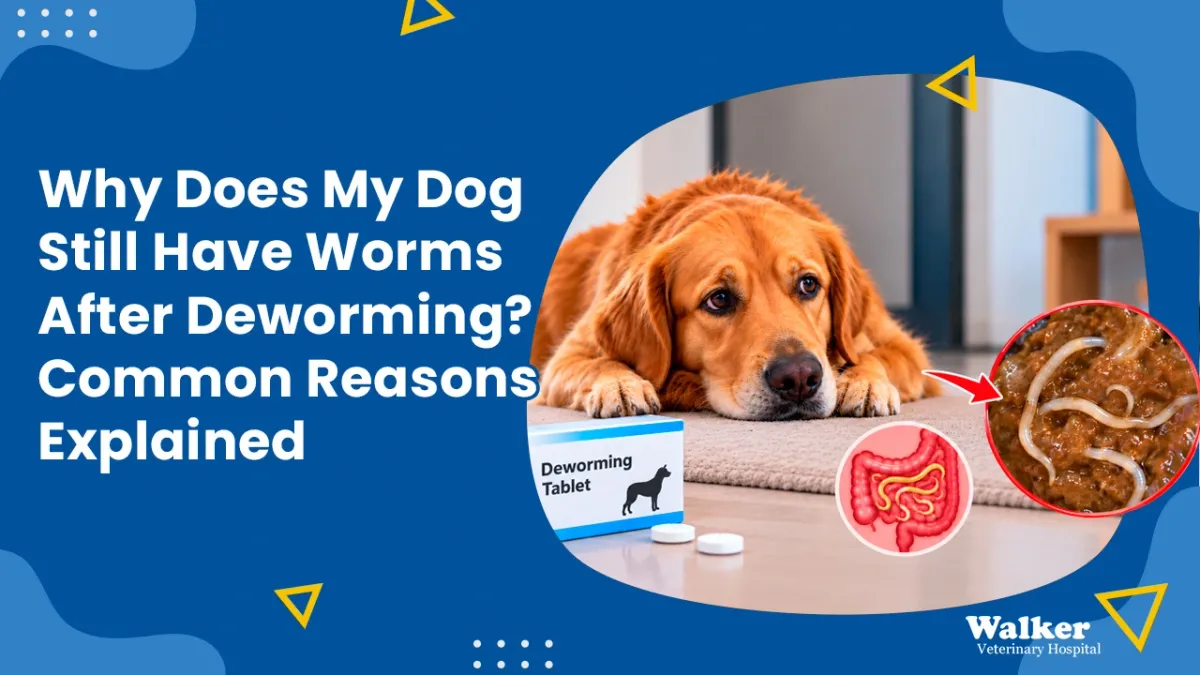
Why Does My Dog Still Have Worms After Deworming? Common Reasons Explained
Seeing worms in your dog’s stool shortly after deworming does not automatically mean the treatment failed. Your dog may be passing worms as the medication takes effect. However, worms that continue to appear or return later can indicate an incomplete treatment course, a medication that does not cover the parasite, or reinfection.
The next step depends on what your dog received, when it was given, and how your dog is feeling. Before giving another dose, contact your veterinarian with those details.
At Walker Veterinary Hospital, we help Stockton pet owners address intestinal parasites and choose an appropriate deworming plan.
Is It Normal to See Worms After Deworming?
Some dogs pass visible worms in the days after treatment. Others do not, even when the medication works. What you see depends on the parasite and the medication used.
Passing a worm shortly after treatment is different from continuing to shed worms after the expected treatment period. Neither the presence nor the absence of visible worms, by itself, confirms that an infection has cleared.
Pay attention to your dog’s overall condition. A dog that is eating, drinking, and behaving normally presents a different situation from one that is vomiting repeatedly, becoming weak, or passing bloody stool.
If your veterinarian did not explain what to expect after the prescribed product, call and ask. There is no single timeline that applies to every dewormer and every parasite.
Common Reasons Your Dog Still Has Worms After Treatment
1. The Medication Does Not Treat That Type of Worm
“Dewormer” describes a category of medications. It does not mean that every product treats every intestinal parasite.
Roundworms, hookworms, whipworms, and tapeworms may require different ingredients or treatment schedules. A product intended for certain intestinal worms may leave another species untreated.
For example, a dog receiving a medication that treats roundworms may still need a different ingredient for tapeworms. Some monthly parasite preventives cover several intestinal worms, but their coverage varies.
Bring the package or a clear photograph of its label to your appointment. The active ingredients matter more than a general description such as “worm medicine.”
2. Follow-Up Treatment Is Part of the Plan
One dose is not always a complete treatment course.
Depending on the medication, treatment may remove susceptible worms in the intestine while immature stages survive elsewhere in the body. Additional treatment may be needed as those stages develop.
This is particularly relevant in puppies. Some roundworm infections begin before birth or through nursing, so a puppy can need scheduled treatment even when its home is clean.
Follow the schedule provided for your dog. Do not stop because the stool looks normal, and do not assume every infection should be treated again at the same interval.
3. Your Dog Did Not Receive the Full Intended Dose
Sometimes the problem is how much medication actually reached the dog.
A tablet may be spat out unnoticed. Medication mixed into food may remain in the bowl. Vomiting shortly after administration can also make it unclear how much was retained.
The prescribed amount must also match the product and your dog’s current weight. This deserves particular attention in a growing puppy.
Tell your veterinarian if any of these situations occurred. Do not automatically replace a vomited dose or double the next one; the safest response depends on the medication and timing.
4. Your Dog Has Been Exposed Again
Successful treatment does not remove parasites from your dog’s surroundings.
Depending on the worm, dogs can become infected through contaminated soil, swallowing infective eggs or larvae, or eating infected prey. Hookworm larvae can also enter through the skin.
A dog may therefore be treated successfully and later develop another infection. Repeated access to contaminated areas can make the problem seem as though it never went away.
Discuss your dog’s routine with your veterinarian, including scavenging, hunting, shared outdoor spaces, and contact with other animals. That information can help identify where repeat exposure may be happening.
5. Fleas Are Allowing Tapeworms to Return
If you keep seeing small segments that resemble grains of rice near your dog’s rear end, on bedding, or in fresh stool, tapeworms are one possibility.
Dogs acquire the common flea tapeworm by swallowing an infected flea, often while grooming. Treating the tapeworm without addressing fleas leaves an opportunity for reinfection.
The plan may need to include flea control for household pets and management of fleas in the home. Products should be selected for each animal’s species, age, and health.
Walker Veterinary Hospital provides flea prevention and treatment guidance to help address this part of the problem.
6. A Persistent Hookworm Infection Needs Further Investigation
Some recurring hookworm infections involve dormant larvae in the dog’s tissues that later become active and reach the intestine.
Drug resistance is another possible explanation. Resistant canine hookworms have been documented in the United States, but seeing worms after treatment does not establish resistance.
Your veterinarian may recommend measuring parasite egg counts before and after treatment to assess the response. This is more informative than repeatedly changing products without knowing why the infection persists.
7. The Remaining Symptoms May Have Another Cause
Continued diarrhea or scooting does not necessarily mean your dog still has worms.
Giardia, a microscopic intestinal parasite rather than a worm, can cause diarrhea and may require a different diagnostic and treatment approach. Scooting can also occur with anal sac problems.
If treatment has finished but symptoms remain, your dog may need reassessment rather than another dose of the same medication. Describe what you are observing instead of assuming every digestive symptom has the same cause.
What Does the Appearance of the Worm Tell You?
Appearance can provide a clue, but it cannot replace identification by a veterinary team.
Many parasite eggs are microscopic, and some intestinal worms are difficult to see.
Take a clear photograph when possible. Ask the hospital whether to bring a fresh stool sample or a sample of the material you found, and how to collect and store it.
How Can Your Vet Check Whether Treatment Worked?
Your veterinarian will usually start by reviewing the original diagnosis, medication, dose, and treatment dates. A stool examination can help identify intestinal parasites and guide the next step.
Walker Veterinary Hospital lists fecal examinations among its laboratory testing services.
One negative stool result does not exclude every parasite infection. For example, tapeworm segments and eggs may not be evenly distributed in a sample, making routine testing less reliable for detecting them. Photographs or collected segments can therefore be helpful.
Ask when your dog should be rechecked. The appropriate timing and test depend on the parasite, treatment, and symptoms.
What to Do If You Still See Worms
Before trying another product:
Check the treatment details. Record the medication name, amount given, and dates.
Note what you are seeing. Describe the material, when it appeared, and whether it has continued or returned.
Review your dog’s condition. Report appetite changes, vomiting, diarrhea, weight loss, or reduced energy.
Contact your veterinarian. Ask whether a sample, examination, or follow-up test is needed.
Continue the prescribed plan. Make changes only after discussing them with the veterinary team.
These details help distinguish expected worm passage from a problem that needs a different approach.
When Does Your Dog Need Urgent Care?
Do not assume significant illness is a normal part of deworming.
Seek urgent veterinary care if your dog has:
Pale gums, marked weakness, or collapse.
Repeated vomiting or an inability to keep water down.
Black, tarry stool or substantial bleeding.
A swollen, painful abdomen.
Severe lethargy or rapid deterioration.
Hookworms can cause serious blood loss, particularly in puppies. Young dogs with diarrhea, poor appetite, or weakness should be assessed promptly.
Call an available veterinary hospital for immediate guidance. An online appointment request is not appropriate for an emergency.
How to Reduce the Chance of Worms Returning
Prevention needs to address both the parasite and the route of exposure.
Pick up feces promptly, including in your own yard. Prevent scavenging and hunting where possible, and follow the flea-control plan recommended for your household.
For roundworms, environmental control can be challenging because the eggs are durable. Prompt waste removal helps prevent contamination; routine household cleaning does not reliably eliminate eggs already established in soil.
Wash your hands after handling pet waste and keep children away from contaminated areas. Some canine intestinal parasites can also affect people.
Ask your veterinarian about year-round parasite prevention and routine fecal testing based on your dog’s age, health, and lifestyle.
Frequently Asked Questions
Can my dog still pass live worms after deworming?
Yes, this can happen shortly after treatment. However, continued passage beyond the period expected for the prescribed medication, or any worsening symptoms, warrants a call to your veterinarian.
Should I deworm my dog again if I still see worms?
Do not give an extra dose simply because you see a worm. Your dog may be passing parasites after treatment, or may need a different medication or scheduled follow-up. Confirm the next step with your veterinarian.
Can my dog have worms even if the stool looks normal?
Yes. Parasite eggs are usually too small to see, and not every infected dog passes visible worms. Normal-looking stool does not replace recommended testing.
Should every pet in the house be treated?
That depends on the parasite and the pets’ shared exposure. Tell your veterinarian about all household animals so each can receive appropriate advice. Do not share one pet’s medication with another.
Get Help With Persistent Worms in Stockton
If worms keep appearing after treatment, bring the medication details and any previous test results to Walker Veterinary Hospital. Our deworming and fecal examination services can help clarify what needs attention.
Call (209) 478-8883 or request an appointment with Walker Veterinary Hospital.
Before giving another dose, find out whether your dog needs time, follow-up testing, or a different treatment plan.